This section outlines our school’s key areas of focus. It reflects our commitment to continuous improvement and responds to the evolving needs of our students. Whether centered on student engagement, social-emotional well-being, or academic growth, our focus guides our learning journey and informs the strategies we implement throughout the year.
2026-2027 School Learning Story Focus: Strengthening Literacy Skills in Different Contexts
School Learning Focus for the 2026-2027 school year |
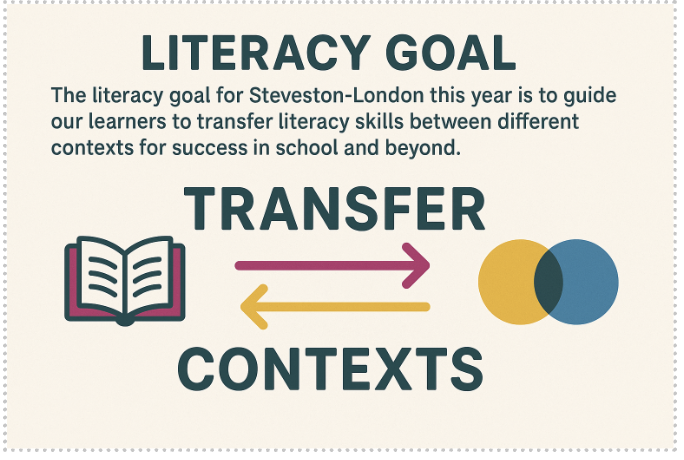
The literacy goal for Steveston-London this year is to guide our learners to transfer literacy skills between different contexts for success in school and beyond. Literacy goes beyond reading — literacy is grounded in everything we do. To have literacy skills is to be able to participate in the world around us by making meaning and contributing ideas. It’s a tool to empower learners. |
Evidence-informed rationale (WHY) | This goal stemmed from a common literacy scan conducted in Fall 2025 and Spring 2026 with grade 8 students. While over 50% of the students achieved an overall score of ‘proficient,’ when the data was broken down, higher-order literacy skills such as inferencing, making connections, and responding, had a higher proportion of Emerging to Developing learners. All students are language learners, and all subject areas have a literacy component. As such, our focus is on having students broadly apply their literacy skills learned in one class to other classes. |
Priority Learners | Grade 8 students |
| Baseline Data | PBAs administered to Grade 8s in Fall 2025 and Spring 2026 looked at the following skills: vocabulary and word skills, identifying main ideas, making connections, making inferences, and responding:
|
Action Statement (HOW) | Executive Functioning skills enable readers to focus, remember what they’ve read, and stay on task which is crucial for understanding texts of all types. Over the last few years, teachers have noticed students struggling with executive functioning skills, especially in grade 8. Executive functioning skills include organization, task initiation, time management, goal setting, and memory and these are the skills that lay out the foundation for success in school and beyond. As a result, this school year, administration, Educational Facilitators, and departments will review literacy data to identify trends, set goals, and determine targeted supports for students. Staff will engage in school-wide discussions to share data and explore strategies to support learners, with a particular focus on executive functioning skills such as organization, task initiation, time management, goal setting, and memory. Staff will also collaborate to provide explicit literacy instruction across subject areas, helping students develop and apply literacy skills in a variety of contexts. Through these efforts, we aim to improve literacy outcomes while fostering a school culture where students and staff feel connected, supported, and equipped for success. |
Intended Impact (SO WHAT) | The intent of this data is to inform and mold practice beyond simply providing strategies. This data should begin changing the way our school approaches literacy as a team effort in better servicing learners and teacher professional development. At different times throughout the year, other formal and informal assessments will be used to verify the efficacy of the strategies and interventions implemented. |
Evidence of Impact (HOW WE WILL KNOW) | Students demonstrate effective literacy strategies learned in one curricular area and apply them to multiple curricular areas:
|
Alignment Statement | Our focus aligns with the District’s Strategic Priority 1: Success for All Learners. By improving literacy, we are ensuring access to learning across all curricular areas and developing key skills for future learning and success. |